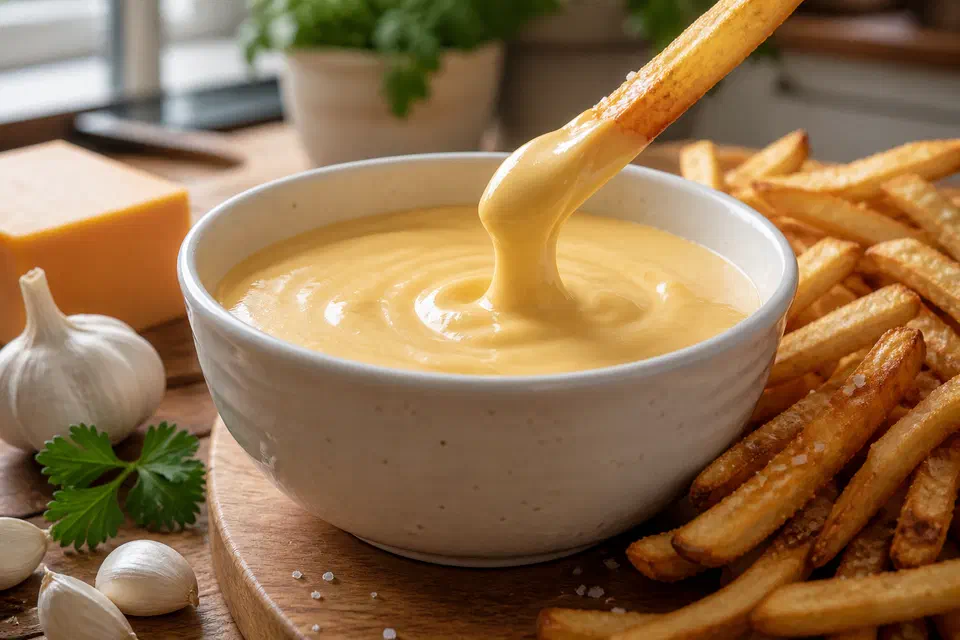
Some foods politely accompany fries. This dip grabs them by the hand and runs away with them.
The secret is a two-cheese alliance: American cheese brings the smooth-melting superpowers, while cheddar brings the sharper, grown-up flavor. Add garlic gently sizzled in butter and you get a glossy, deeply savory sauce in about 10 minutes. Better still, you can make it on the stovetop or in a microwave.
The golden rule: gentle heat wins. Cheese sauce does not need a volcanic phase.
🧀 Recipe at a Glance
| Preparation time | 5 minutes |
| Cooking time | 5 minutes |
| Total time | 10 minutes |
| Yield | About 300g, or 4–6 dipping portions |
| Difficulty | Easy |
| Best served with | Fries, wedges, nachos, burgers, pretzels, or roasted vegetables |
🛒 Ingredients
| Ingredient | Quantity | What it does |
|---|---|---|
| Low-fat milk | 80g | Adds water and keeps the sauce pourable |
| Butter | 15g | Softens the garlic and carries its aroma |
| Fresh garlic, finely minced or grated | 8g | Brings the savory fireworks |
| American cheese slices, torn into pieces | 80g (about 4 slices) | Creates the stable, silky base |
| Light cheddar, freshly grated | 115g | Adds proper cheddar flavor and body |
Grate the cheddar yourself. Pre-grated cheese is often coated with starch or cellulose to stop it clumping in the bag; those coatings can make a sauce less smooth.
🍳 Stovetop Method
1. Wake Up the Garlic
Melt the butter in a small saucepan over medium-low heat. Add the garlic and cook for 30–40 seconds, stirring, until fragrant.
Do not let it brown. Golden garlic can be lovely elsewhere, but in this quick sauce it can move from sweet to bitter before you have found a fry to test it with.
2. Warm the Milk
Pour in the milk and stir until warm and lightly steaming. Do not boil it.
3. Build the Smooth Base
Add the torn American cheese a few pieces at a time. Stir continuously until it has completely melted and the mixture looks smooth.
4. Finish with Cheddar
Turn the heat off. Add the grated cheddar in two or three handfuls, stirring until each addition melts before adding the next. The residual heat should produce a glossy, spoon-coating dip.
5. Deploy the Fries
Serve immediately. If the dip becomes thicker as it stands, stir in warm milk one teaspoon at a time until it returns to dipping consistency.
⚡ Microwave Method
Use a microwave-safe bowl with at least 1 litre of capacity so there is room to stir without redecorating the microwave in cheddar.
- Add the butter and garlic to the bowl. Microwave for 20 seconds, stir, then heat for another 10–20 seconds until the butter is melted and the garlic smells fragrant but has not browned.
- Stir in the milk and microwave for 30–45 seconds, until hot but not boiling.
- Add the American cheese. Microwave in 15-second bursts, stirring thoroughly after each one, until completely smooth. This normally takes 45–75 seconds in total.
- Add the grated cheddar in two or three batches. Stir vigorously after each addition, using the heat already in the bowl. If needed, microwave for one final 10-second burst—no longer—then stir until glossy.
- Rest for 30 seconds, stir again, and serve.
Microwave power varies. These timings suit roughly 700–1000W machines, but the visual cues matter more than the clock: hot milk, fully melted American cheese, and no bubbling after the cheddar goes in.
🔬 Why This Sauce Works
This is not merely melted cheese. It is an emulsion: tiny droplets of fat are dispersed through water from the milk. Left unsupervised, melted cheddar tends to separate into oily fat and clumped proteins. The recipe gives those natural enemies a very competent mediator.
American Cheese Is the Emulsion Insurance
American cheese contains emulsifying salts—often sodium citrate, sodium phosphates, or both. These salts interact with calcium in the cheese and help loosen tightly linked casein proteins. The proteins can then spread through the liquid and surround fat droplets, keeping water and fat together in one smooth sauce.
That is why the American cheese goes in first: it establishes a stable base before the more temperamental cheddar joins the party.
Turning Off the Heat Protects the Cheddar
High heat makes cheese proteins tighten and squeeze out water and fat, which can turn a silky dip grainy or greasy. Adding the cheddar off the heat lets residual warmth melt it without pushing the proteins too far.
Light cheddar can be a little less forgiving than full-fat cheddar because its balance of fat, protein, and moisture is different. Exact recipes vary by brand, but gentle heat is always the useful move.
Garlic Has a Tiny Chemistry Plot Twist
Cutting or grating garlic breaks its cells and allows the enzyme alliinase to form allicin, the compound behind fresh garlic’s sharp aroma. Heat quickly transforms allicin into other sulfur compounds with rounder, cooked flavors. The brief butter sizzle takes off the raw edge while the fat helps carry those aromas throughout the sauce.
Why It Thickens as It Cools
As the dip cools, the fat becomes firmer and the protein network moves less freely, so the sauce thickens. A splash of warm milk adds water and heat, loosening the network again. Cold milk also works in an emergency, but it temporarily cools and tightens the dip before it warms through.
Fun fact: cheese sauce looks like one uniform liquid, but at microscopic scale it is a busy suspension of water, proteins, dissolved salts, and tiny fat droplets. Your saucepan is hosting a very small peace conference.
🧯 Troubleshooting the Cheese Situation
| Problem | Likely cause | Rescue plan |
|---|---|---|
| Too thick | It cooled or lost moisture | Stir in warm milk, 1 teaspoon at a time |
| Too thin | Too much milk or not enough cheese | Rest for 1–2 minutes, or add a little more American cheese |
| Grainy | Cheddar was overheated or added too quickly | Remove from heat and whisk in 1–2 teaspoons of warm milk |
| Greasy or split | Excess heat tightened the proteins | Take it off the heat and whisk vigorously with a splash of warm milk |
| Garlic tastes bitter | It browned before the milk was added | Start again; unfortunately, cheese cannot negotiate with burnt garlic |
🎛️ Make It Your Dip
- Smoky: Add ¼ teaspoon smoked paprika.
- Spicy: Stir in hot sauce, cayenne, or finely chopped pickled jalapeños.
- Tangy: Add ½ teaspoon Dijon mustard after the cheddar melts.
- Peppery: Finish with plenty of freshly cracked black pepper.
- Loaded fry mode: Top with sliced spring onion, crispy onions, or chopped pickles.
Add salty ingredients only after tasting. American cheese already contributes a substantial amount of salt, and the fries will probably arrive seasoned too.
🧊 Storage and Reheating
Cool leftovers promptly, cover, and refrigerate for up to 3 days. Reheat gently in a saucepan over low heat or microwave in 15-second bursts, stirring between each burst. Add a teaspoon or two of milk as needed.
Freezing is not recommended: ice crystals and thawing can disrupt the emulsion and leave the sauce grainy.
Do not leave the dip at room temperature for more than 2 hours. Dairy may be delicious, but it is not immortal.
🍟 Final Thoughts
The clever part of this recipe is not complexity; it is order. Garlic meets butter, milk brings moisture, American cheese builds a stable emulsion, and cheddar arrives off the heat with the flavor. Follow that sequence and five ordinary ingredients become a sauce with the structural integrity to survive an enthusiastic pile of fries.
Now all that remains is the hardest scientific question of the evening: one dip per fry, or the forbidden double-dip?